
DNX Tech Update: June-July
As part of our routine, we invest heavily in improving our open source stack and making sure knowledge is captured in the form of code. DNX One Last month our main focuses were on compliance and data. Compliance terraform-aws-security-baseline — This module setup alerts for common controls defined on the CIS AWS Foundations Benchmark. terraform-aws-ecs — Our ECS Cluster […]
An unexpected journey from SAP consultant to AWS cloud architect

It has been three months since I decided to completely reshape my career moving from an SAP senior consultant role to an AWS cloud solutions architect role. I knew this was an unconventional move, and several risks were involved in the process, but it has been a marvellous experience so far, and today I can talk with […]
AWS Amplify: Create Custom Resolvers Programmatically (to fetch data from AWS RDS databases)

AWS Amplify is an amazing open-source project from AWS that helps you build secure, scalable mobile and web applications. In this post, I will help you to create custom resolvers programmatically in AWS Amplify without relying on the AWS Console and keeping everything as code that in the past, you either needed to use the […]
Upgrade Elasticsearch from 2.3 to 7.4

Photo by Marten Newhall on Unsplash Sometimes it is common just to deploy a Elasticsearch domain at AWS and forget to keep it up-to-date with the latest version. After a while, you realize that it’s five major releases behind the stable version and there’s no straight path to upgrade. The idea of this post is to show the […]
AWS ECR — Improving container security by using Docker image scanning

Photo by Bernard Hermant on Unsplash Following the HIPAA compliance along with our Foundation and application modernisation, we have been asked to add more security layers, especially on the application modernisation step. How to create a docker image repository? In your AWS console on the search bar, look for ‘Elastic Container Registry’ and then ‘Create repository’. You will see this […]
DNX Tech Update: April-May
At DNX we are committed to democratizing cloud technologies. Part of our plan is to develop and release to the public a large part of what we use with our clients. After a little more than 1 year, this strategy translated into: And here’s our update of that happened in the last few months. DNX […]
Using Multiple Buckets AWS Amplify
From the Amplify documentation, we can consider that AWS Amplify is a development platform for building secure, scalable mobile and web applications. It makes it easy for you to authenticate users, securely store data and user metadata, authorize selective access to data, integrate machine learning, analyze application metrics, and execute server-side code. Amplify covers the […]
Multi developer environments on AWS using Gitlab + Terraform + Serverless + React

We are using Gitlab to deploy our applications directly to AWS through pipelines. If you never heard about Gitlab (https://about.gitlab.com/stages-devops-lifecycle/), please feel free to read the Gitlab’s white papers and understand more about the tools. Maybe you are wondering why we don’t use Github/Actions to deploy our applications, and I’ll answer you with a simple […]
Reducing AWS costs by turning off development environments at night— the easy way (without Lambda)

Why keep your non-production environments up when nobody is up? An environment in AWS usually is a group of these resources: In this tutorial, we will show how to turn off the most costly members of an environment: EC2 and RDS instances. By shutting it down outside working hours, you can cut by around 50% […]
Exporting Cloudwatch Logs automatically to S3 with a Lambda function
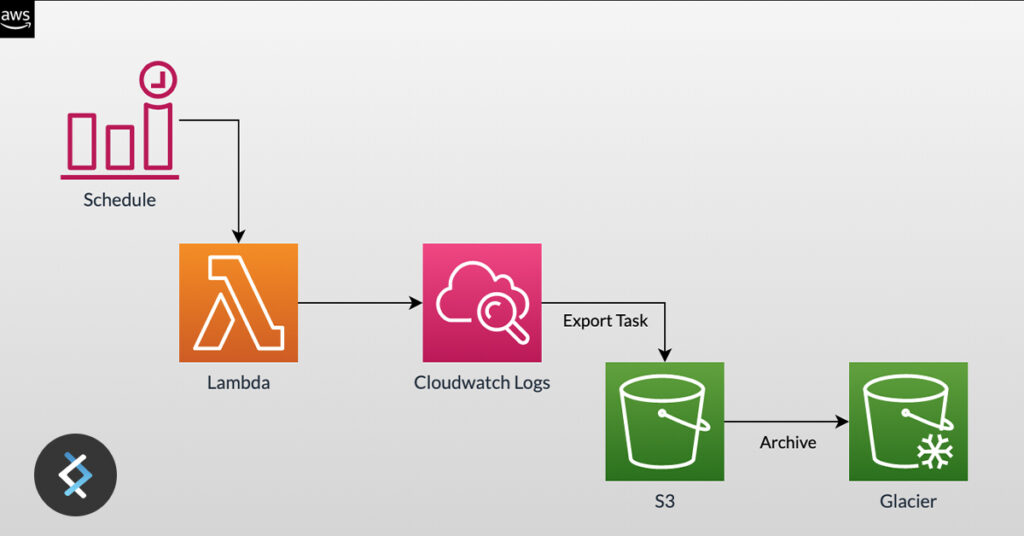
The missing feature of Cloudwatch Logs. Your Cloudwatch Log Groups could look something like this: As you might guess, after the retention time, logs are deleted. And that’s a good approach for keeping the costs under control, but sometimes regulation mandates that logs are stored longer than this period. Luckly, AWS allows you to export […]