
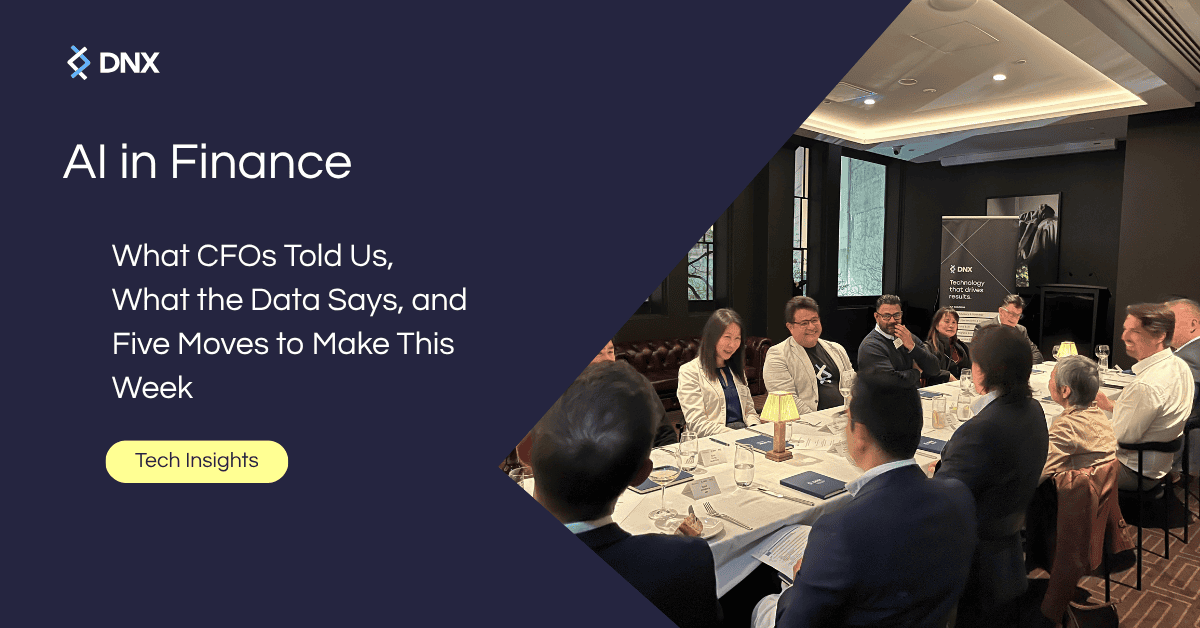
Findings from the DNX and AWS AI in Finance Roundtable, Sydney, September 2026
In September, DNX and AWS brought a group of CFOs and senior finance leaders together in Sydney, from retail, manufacturing and financial services, to talk plainly about where AI actually stands in their businesses. What came out of it lines up closely with a year’s worth of published research on AI in finance, which says more about how real these five problems are than anything we could have written ourselves.
If you were at the roundtable, here’s the recap. If you weren’t, here’s what you missed, what the research backs up, and five moves worth making this week.
1. Data trust is what’s actually stalling things, not technology
In the room: One attendee had already tried outsourcing an AI underwriting tool. It failed, so they built their own finance data mart from scratch because the vendor’s version couldn’t be trusted with their numbers. Another had watched a colleague’s AI-generated forecast drift so far from reality within a single month that it became unusable. A third had been told flatly by their own IT team that pulling certain data into the data lake would crash it.
What the research says: KPMG’s Global AI in Finance 2026 study, covering more than a thousand senior finance leaders, found active AI use in finance has more than doubled since 2024, with three quarters of finance functions already running it in production and 71% reporting it’s meeting or beating ROI expectations. Over a third name data quality as both the reason it’s working and the reason it isn’t working faster. Locally, ADAPT found 86% of Australian organisations are still exploring agentic AI rather than scaling it, and KPMG’s Australian data shows 13% have no plans to touch generative AI at all, against 1% globally. The Australian Bureau of Statistics tells a slightly different part of the story: its most recent Business Characteristics Survey found AI use across Australian businesses sitting at 12%, up from 1% in 2021-22, with financial and insurance services the fastest-growing sector in the country at twenty-four times its 2021-22 level.
Read against the stories from the room, that combination looks like a group of people who’ve already been burned, or watched someone else get burned, and are now moving carefully.
Key action: work out specifically which of your data sources you’d genuinely let an AI system act on without a human checking it first. This list is the most useful thing you’ll learn this quarter. When you take it to the board, open with a specific cost rather than “our data needs work” (e.g. a reconciliation that ran three weeks over, a forecast that had to be pulled and redone), and ask for something bounded in return: a few people, a defined set of data sources, a fixed number of days, a usable result at the end of it.
2. Deployment is outrunning any real sense of value
In the room: Several people in the room described the same frustration without naming it the same way. AI has made it trivial to produce another dashboard, another forecast, another deck, and nobody stops to ask whether any of it changed a decision. One attendee, six weeks into a transformation programme in a new role, put it simply: the hard part isn’t the tools any more, it’s getting anyone to act differently because of what the tools produce.
What the research says: Gartner’s finance research practice said much the same thing in May 2026: CFOs need to stop mistaking AI deployment for AI value, because adoption is racing ahead of it. That note landed four months before the room said the same thing, apparently without having seen it.
Key action: pick two AI use cases that are already live in your business, including the informal ones, and put an actual number against what changed: hours, errors, speed, anything measurable. If you can’t find that number, you’ve found your next project, and it costs nothing to start looking for it.
3. Shadow AI use is already happening, and nobody’s counting it
In the room: Almost as an aside, someone in the room mentioned that staff were quietly using personal AI accounts because the sanctioned tools felt too slow or too locked down, sometimes with information that should never have left the building.
What the research says: Deloitte’s most recent CFO Signals survey found 43% of CFOs admit they lack full visibility into which AI tools are actually running across their organisation, and 59% say balancing speed against risk is their hardest governance call. That gap is sitting in close to half the businesses in the room that night, unmeasured, right now.
Key action: ask every team lead, directly, what AI tools they’re actually using day to day, not what’s on the approved list. The gap between those two answers is the highest-value governance fix available to you this month, and it costs nothing but an afternoon of honest conversations.
4. Finance has a claim on AI ownership that almost nobody else in the business does
In the room: The sharpest line of the night came from an AWS executive, watching the room debate reconciliation: finance, IT and HR are the only three functions with genuine end-to-end visibility across a business. Everyone else sees their slice. One attendee described a US CFO who already treats AI token spend as a straight capital allocation decision, the same line item as headcount, same rigour, same sign-off, whether the work is done by an agent or a person.
What the research says: The research doesn’t settle this one either way. Oliver Wyman’s CFO Agenda 2026 survey found 76% of CFOs now treat technology and AI as a growth lever, and 68% expect finance to take on more of the analytics and scenario work, so the appetite for a bigger seat is real. But the industry’s own benchmark data points the other way on where AI spend actually ends up being governed: the FinOps Foundation’s 2026 survey found 78% of FinOps teams now report into a CTO or CIO, up eighteen points since 2023, against 8% reporting into a CFO. Gartner’s own advice isn’t finance ownership either, it’s a cross-functional AI council, because only 10% of CFOs are responsible for AI execution beyond finance to begin with.
Ownership is contested territory right now, which if anything makes claiming it early more valuable.
Key action: before your next budget cycle, put one sentence in front of your CFO or your board: AI spend should be tracked and justified the same way every other capital decision is, and finance should own that reporting. Say it as a claim, not a question. This is the one to move on first, not last, precisely because the ground is still up for grabs, and defaults tend to land with IT simply because nobody else asked first.
5. The seniority gap is a people problem dressed up as a technology problem
In the room: Every attendee described some version of the same split: junior and middle finance staff moving fast, senior executives, and at least one board chair, sitting the whole thing out. And in nearly every business represented, someone on the finance team had quietly become the person everyone asks when something needs automating. Almost none of them had been given a platform to show it.
What the research says: Gartner’s Sydney-based research names acquiring and developing AI talent as CFOs’ top near-term challenge nationally, and its advice was to develop the people already in the building rather than hire specialists.
Key action: find the person on your team who’s already the one everyone asks when something needs automating, and give them fifteen minutes at your next team meeting to show one thing they’ve built. It will do more for the seniority gap in your business than a training budget ten times the size.
Act On the One That Landed
For the people who were in that room, the notable part is that five problems, each described from inside a different business, landed in almost exactly the same place as a year of research covering thousands of companies. That match is worth trusting on its own. For everyone reading this who wasn’t there, all five are answerable inside your own business this week, starting with whichever one you recognised before you’d finished reading it.
Do you know where your data gap sits?
If you want a second set of eyes, DNX can help scope it: a defined team, a defined set of sources, a fixed number of days, with something usable at the end rather than a roadmap.